
We play because we are human, and we need to understand what makes us human. (p. 15)
Play Matters by Miguel Sicart
I spent a considerable amount of time reading and learning about play during the last several months. I articulated this as one of my goals in my plan for my sabbatical.
I will spend time learning and researching more about play within early childhood and other contexts. This learning will help to inform potential changes to Play and Learning in Early Childhood (ER 2155) as well as provide a foundation of knowledge for my work in expanding a thematic pathway and developing a capstone course in General Education (INCAP) focused on play.
I wasn’t sure what I would discover as I started this work and I didn’t know exactly what I wanted to learn about play. I didn’t really have a detailed plan for my reading. It was an emergent process that started with a book on my bookshelf, Lisa Murphy on Play: The Foundation of Children’s Learning. I mostly took notes after I finished reading, because I wanted to immerse myself in the words of the writer without considering what I learned. I highlighted key quotes as I read and then used them to capture what interested me in the reading as well as potential ideas for the courses. I spent about two and half months focused solely on learning about play and I could have spent even more time on this work. I stopped at this point, not because I didn’t have more to read and learn, but I knew that I wanted to spend time on the other aspects of my sabbatical project as well.
Early in my work, I focused on reading a variety of books. I purposefully made this decision to allow me time to consider an author’s perspective for more than just a few pages. This time was wonderful and something that I treasured as I feel often that I don’t have time for this type of deep reading in the typical semester. As I mentioned in a previous post, this was such a joyful experience that I am thinking about how I can carve out time for this type of reading during a typical semester. I also spent time exploring shorter resources such as journal articles, videos, and other materials related to play. I spent a significant amount of time exploring the American Journal of Play, an open access journal from the Strong National Museum of Play, because it was new to me and I also thought it could be a potential resource for students.
There are many ideas that I could write about. I have pages and pages of notes with many quotes from these materials. I reviewed this work before writing this post. I selected some of the quotes that resonated with me and decided to use these words as a starting point. I noticed several themes repeated in these ideas and thought I could organize the authors’ words in this manner. I am sure that if I read through my notes at another point in time, I would select different quotes and organize them in another way. But here is my first iteration of these ideas.
What is play?
The first theme I noticed focused on the concept of play. What is play exactly? How do we know if something is play? I thought that I had a grasp on the idea of play until I started reading these varied perspectives. I realized that this question is much more complex and there are many ideas to consider. I found it interesting to think about this question and to see how different authors approached defining key elements of play whether it is how young children, adults, or animals play.
In many of the readings, the author would articulate specific aspects of play. For example, Stebbins writes,
…play is self-initiated, self-ended, and open-ended… (p. 8)
The Interrelationship of Leisure and Play: Play as Leisure, Leisure as Play by Robert A. Stebbins
There is not consensus on a definition of play. This variation comes from different disciplinary perspectives about play as well as the variation among playful experiences. Sutton-Smith articulates part of this idea in the following quotation.
The ambiguity of play, as well as lying in this great diversity of play forms, owes some of its force to the parallel diversity of the players. There are infant, preschool, childhood, adolescent, and adult players, all of whom play somewhat differently. (p. 5)
The Ambiguity of Play by Brian Sutton-Smith
Other resources focused more on an individual’s experience and how this perspective helps us to understand the essential elements of a play experience. For instance, Rosen writes,
Being in play, being in the state of mind that says, ‘I wonder what might happen if I tried this’ and then not worrying or being afraid of the outcome, is a state of mind that can cope with the unexpected. (p. 20)
Michael Rosen’s Book of Play! Why Play Matters, and 101 Ways to Get More of it in Your Life by Michael Rosen
Or here, Duncan describes play from the point of view of the child engaged in the experience.
For instance, research suggests that, from a child’s perspective what defines play is not a predetermined or specific activity but the nature of the engagement (its affect, its context, the significant others, or the objects involved) in any activity and the interactions between them. (p. 68)
Pigs, Planes, and Play-Doh: Children’s Perspectives on Play as Revealed through Their Drawings, American Play Journal, by Pauline Agnieszka Duncan (Fall 2015)
Why play?
Another recurring theme in the readings focused on the benefits of play. While I have knowledge about this topic, I learned more about the critical role of play in development of children as well as the beneficial aspects of play for adults, which is an area that I have not explored in depth before.
To me, the quote below highlights how important play is for all, no matter how old we are.
Play is fun, fun is pleasurable, enjoyable carefree—healthy. Play is healthy. Playful fun, fun-filled play has a serious important developmental function, innumerable clinical studies show it—happy people are healthier than unhappy people, and this statement has been verified for people at all stages of life, from infancy through old age. (p. 13)
Celebrating 40 Years of Play Research: Connecting Our Past, Present, and Future Edited by Michael M. Patt & John A. Sutterby
Sometimes in the readings an author articulated how a particular type of play is beneficial. Such as the following quote from Lanza.
Free play, as it turns out, is a fundamental building block of a good life throughout the human life span, not just during the childhood years. (p. 5)
Playborhood: Turn Your Neighborhood into a Place for Play by Mike Lanza
Other times I came across why play is important particularly to young children. Murphy articulates how schools are sometimes not aligned with these developmentally appropriate practices.
When children have limited access to outdoor places and are kept inside too long, they begin to exhibit behaviors that are treated as behavior problems, even though they are not. They are actually expectation problems. (p. 88)
Lisa Murphy on Play: The Foundation of Children’s Learning by Lisa Murphy
Schore highlights the important elements of play infants learn when engaged in responsive relationships with caregivers.
Play calms and soothes infants, and it modulates their stressful states of negative arousal, replacing stress with intense joy and excitement. (p. 117)
Playing on the Right Side of the Brain: An Interview with Allan N. Schore, American Journal of Play (Winter 2017)
Another idea addressed in the readings relates to Sanseter & Sando’s words below. Play can be a safe space for exploration.
Driven by curiosity and a need for excitement, children approach the world around them through play. Rehearsing real-life, risky situations, they discover is safe and what is not. (p. 180)
“We Don’t Allow Children to Climb Trees” How a Focus on Safety Affects Norwegian Children’s Play in Early-Childhood Education and Care Settings, American Play Journal, by Ellen Beate Hansen Sandseter and Ole Johan Sando (Winter 2016)
One element I enjoyed as I read related to uncovering new play experts or theorists. These new perspectives opened up my thinking to understanding play through another disciplinary lens or another context.
Early in my reading, I came across several authors that mentioned Csikszentmihalyi’s work about flow experiences. Csikszentmihalyi describes insights from interviews with a variety of individuals that highlight similar experiences when immersed in what could be described in some contexts as play.
The best moments usually occur when a person’s body or mind is stretched to its limits in a voluntary effort to accomplish something difficult and worthwhile. Optimal experience is thus something that we make happen. (p. 3 )
Flow: The Psychology of Optimal Experience by Mihaly Csikszentmihalyi
Another name that I came across often in my reading was that of Henricks and his prolific work about play. In the following quote, he describes the emotional benefits of play. I thought about these words particularly within the context of the current moment. How has the pandemic shifted how we play?
Players want the full arsenal of emotions and emotion-based behaviors. Still, it is not play’s spirit to leave people in misery. Rather, play converts negative feelings into positive ones by providing opportunities for people to extricate themselves from simulated distress and damage. (p. 226)
Play and the Human Condition by Thomas S. Henricks
Finally, Johnson describes another potential benefit of play in his book, Wonderland: How Play Made the Modern World. He writes about how humans quest for fun influenced fashion and shopping, music, taste, illusion, games, and public space. As he articulates below, play has influenced many of the world’s inventions that turned into important innovations beyond their first playful moments.
Because play is often about breaking rules and experimenting with new conventions, it turns out to be the seedbed for many innovations that ultimately develop into much sturdier and more significant forms. (p. 15)
Wonderland: How Play Made the Modern World by Steven Johnson
How do we support play?
Another theme that emerged related to the ways in which we can support play. This can be in our work as caregivers of young children or in how we set up the environment to support time for play.
For instance, the following quote highlights the important role of the playworker.
Recognizing that everyone working with children has responsibilities to care for them, playworkers have a very special responsibility to encourage the setting-up of play opportunities that are self-directed, freely chosen and encourage children to socialize, take decisions and develop the important skill needed in adulthood. (p. 18)
Foundations of Playwork Edited by Fraser Brown and Chris Taylor
Several readings focused on the objects children use during play and how these materials shape the ways children engage in the play. Dougherty writes,
If you want to prepare a generation of children for a changing world, change the toys they play with. (p. 119)
Free to Make: How the Maker Movement is Changing Our Schools, Our Jobs, and Our Minds by Dale Dougherty with Ariane Conrad
Ness & Farenga expand on these ideas in the quote below.
We believe that the loss of cognitive intrigue results from the use of play objects tied to predetermined conclusions, especially those reinforced by rote instruction, exemplified by toys, games, and lessons that are an end in themselves and require an individual only to master the planned objectives. (p. 208)
Blocks, Bricks, and Planks: Relationships between Affordance and Visuo-Spatial Constructive Play Objects, American Play Journal, by Daniel Ness & Stephen J. Farenga (Winter 2016)
Some authors discussed some of the challenges of supporting play. For example, Bordova & Leong write,
Many adults—parents and teachers alike—have difficulty engaging in playful interactions with children because their own childhood was marked by this deterioration of free play. This intergenerational play deficit we witness first-hand in our work may be attributable to the effects of a ‘remote control childhood’ (Levine 1998). The remote control generation is now raising a new generation of kids who cannot play. (p. 41)
Making Play Smarter, Stronger, and Kinder: Lessons from Tools of Mind, American Journal of Play, by Elena Bodrova and Deborah J. Leong (Fall 2019)
In this interview from the American Journal of Play, Jarrett describes how we might co-opt children’s play in the name of safety. This in turn doesn’t support children’s play or physical development.
But if playground equipment is designed to be too safe, children don’t want to play on it or they misuse the equipment to make it more risky. (p. 150)
From Playing to Play Advocacy: An Interview with Olga S. Jarrett, American Journal of Play, (Winter 2019)
Other authors describe the ways we do not provide enough time for children’s play. For instance,
…when children have a ten- or fifteen-minute period for pretend play, they are barely able to start because arranging the setting and deciding on the theme is about all they can accomplish in the time allotted. (p. 148)
Play, Toys, Learning, and Understanding: An Interview with Doris Bergen, American Journal of Play (Winter 2016)
Professional Development Opportunities
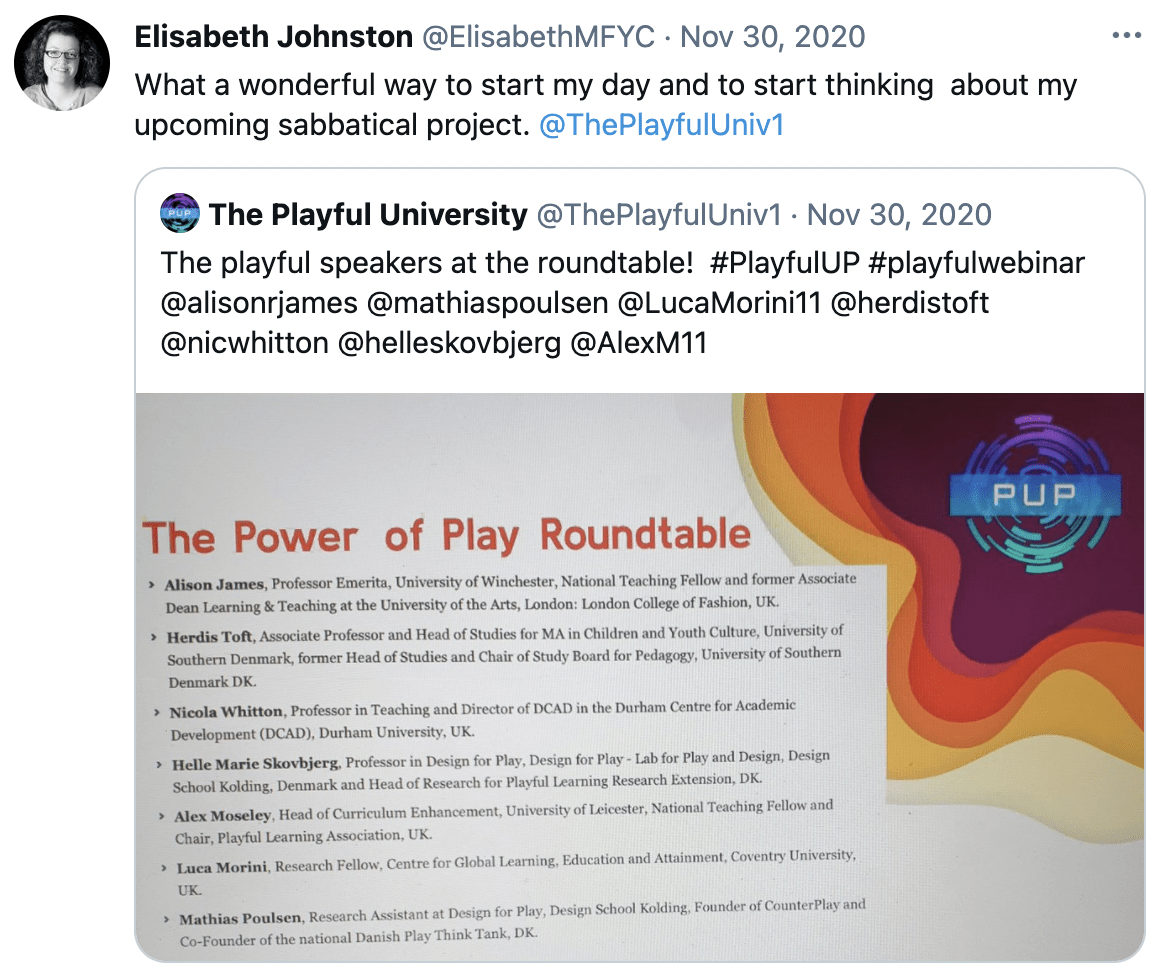
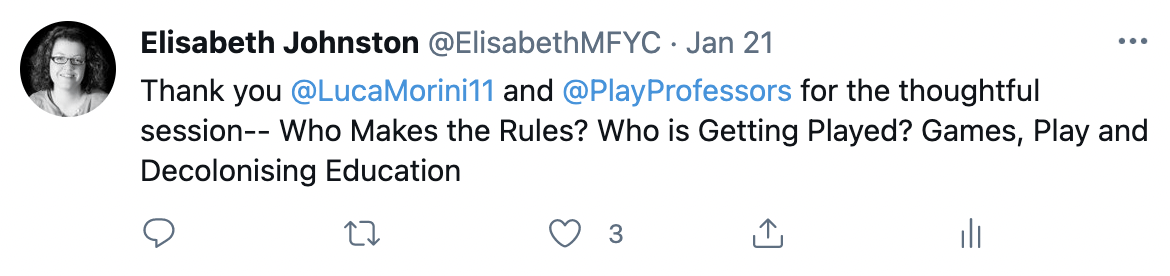
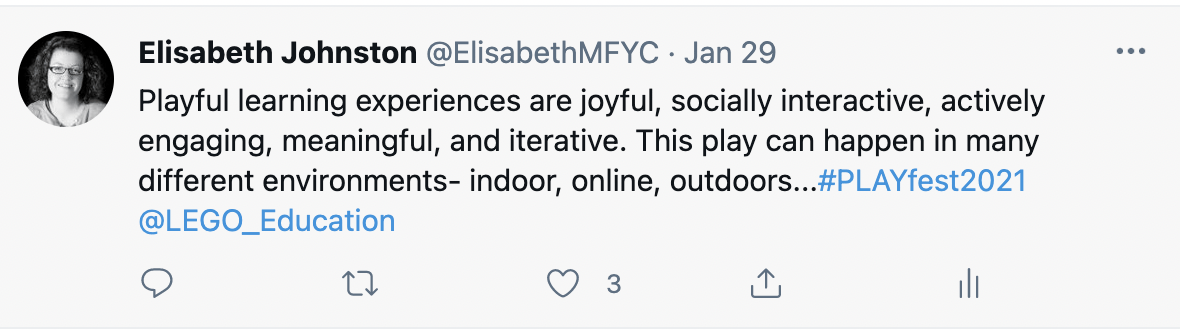
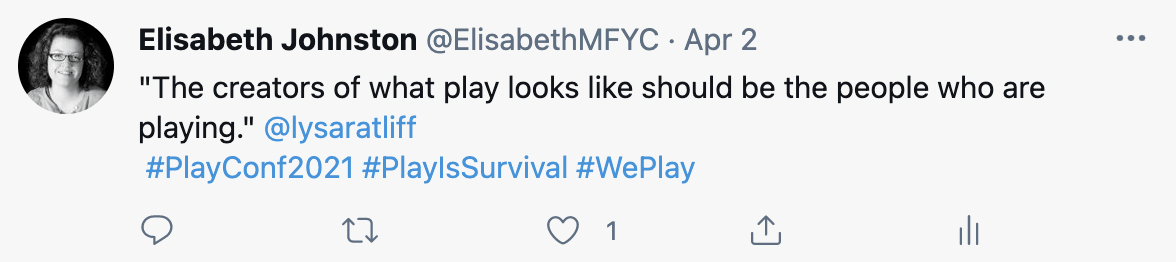
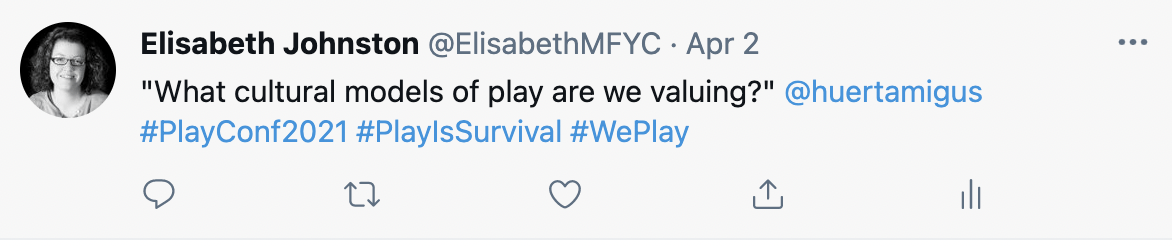
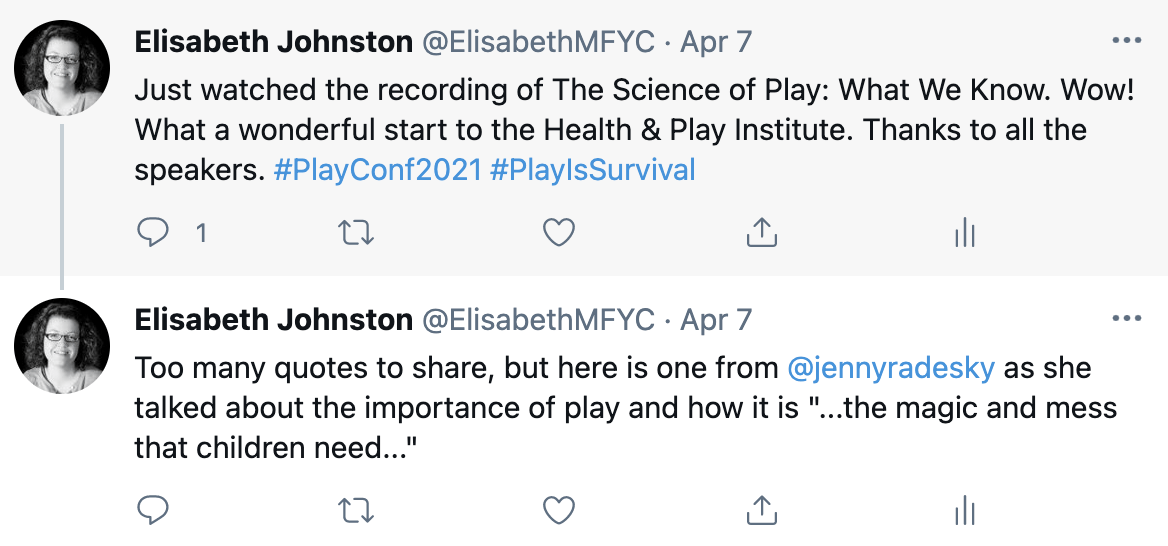
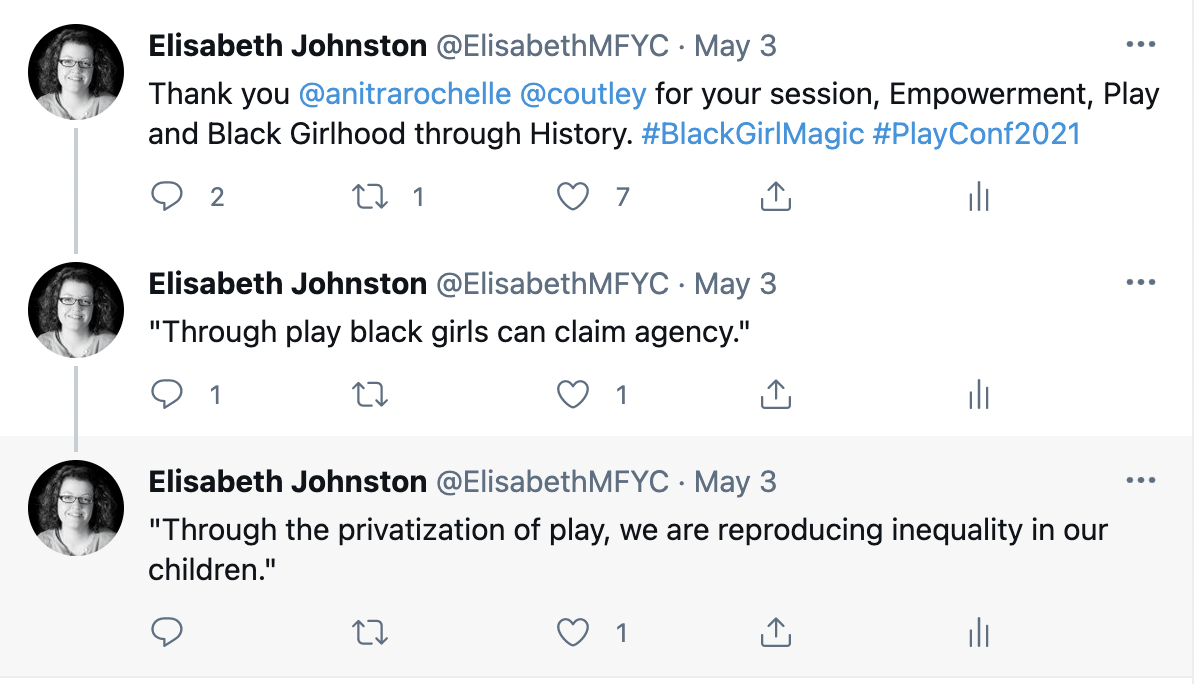
Besides reading, I had the opportunity to engage in several professional development opportunities. One of the positive outcomes of the pandemic is that I was able to participate in more of these experiences because of the virtual connections available online. I had the opportunity to connect with play experts from all of the world. These presentations and conversations gave me new ideas to consider or new ways to rethink my understandings. Below you will find some of my Tweets related to these experiences.




Final Thoughts
I thought I would end this post with the following quote. As Mintz, describes, play is in decline and it is important to consider how to advocate for everyone’s opportunities for play.
In our own time, for example, a sharp decline in the birthrate, the rebirth of feminism, the emergence of intense parenting, the growth of new electronic technologies, and heightened concerns for children’s well-being have all had profound consequences for children’s play. Free, unstructured, outdoor play has declined markedly, and it has been replaced to a striking extent by solitary play and adult-supervised activities. (p. 145)
Play and the History of American Childhood: An Interview with Steven Mintz, American Play Journal (Fall 2010)
Spending this time reading and learning reemphasized this importance and provided me with many ideas of potential ways students in the INCAP could advocate for play in different contexts. I am excited to continue thinking about this work and supporting my students in considering how they might advocate for play.
A List of What I Explored
Books
- Foundations of Playwork Edited by Fraser Brown and Chris Taylor
- Play: How it Shapes the Brain, Opens the Imagination, and Invigorates the Soul by Stuart Brown
- Flow: The Psychology of Optimal Experience by Mihaly Csikszentmihalyi
- Free to Make: How the Maker Movement is Changing Our Schools, Our Jobs, and Our Minds by Dale Dougherty with Ariane Conrad
- Play and the Human Condition by Thomas S. Henricks
- Wonderland: How Play Made the Modern World by Steven Johnson
- Playborhood: Turn Your Neighborhood into a Place for Play by Mike Lanza
- Lisa Murphy on Play: The Foundation of Children’s Learning by Lisa Murphy
- The Boy on the Beach: Building Community Through Play by Vivian Gussin Paley
- Celebrating 40 Years of Play Research: Connecting Our Past, Present, and Future Edited by Michael M. Patt & John A. Sutterby
- Michael Rosen’s Book of Play! Why Play Matters, and 101 Ways to Get More of it in Your Life by Michael Rosen
- Play Matters by Miguel Sicart
- The Interrelationship of Leisure and Play: Play as Leisure, Leisure as Play by Robert A. Stebbins
- The Ambiguity of Play by Brian Sutton-Smith
- Alone Together: Why We Expect More from Technology and Less from Each Other by Sherry Turkle
- The Art of Tinkering by Karen Wilkinson & Mike Petrich
Articles from American Journal of Play
- Sesame Street and Learning Through Play: An Interview with Rosemarie T. Truglio (Fall 2019)
- Making Play Smarter, Stronger, and Kinder: Lessons from Tools of Mind by Elena Bodrova and Deborah J. Leong (Fall 2019)
- From Playing to Play Advocacy: An Interview with Olga S. Jarrett (Winter 2019)
- Playing on the Right Side of the Brain: An Interview with Allan N. Schore (Winter 2017)- p. 117
- Active Play: Exploring the Influences on Children’s School Playground Activities by Brendon Hyndman, Amanda Benson, and Amanda Telford (Spring 2016)
- Play, Toys, Learning, and Understanding: An Interview with Doris Bergen (Winter 2016)
- “We Don’t Allow Children to Climb Trees” How a Focus on Safety Affects Norwegian Children’s Play in Early-Childhood Education and Care Settings by Ellen Beate Hansen Sandseter and Ole Johan Sando (Winter 2016)
- Blocks, Bricks, and Planks: Relationships between Affordance and Visuo-Spatial Constructive Play Objects by Daniel Ness & Stephen J. Farenga (Winter 2016)
- Inserting Child Initiated Play into an American Urban School District after a Decade of Scripted Curricula: Complexities and Progress by Julie Nicholson, Anne Bauer, and Ristyn Woolley (Winter 2016)
- Pigs, Planes, and Play-Doh: Children’s Perspectives on Play as Revealed through Their Drawings by Pauline Agnieszka Duncan (Fall 2015)
- Imagination, Playfulness, and Creativity in Children’s Play with Different Toys by Signe Juhl Møller (Spring 2015)
- More Play, Please: The Perspective of Kindergarten Teachers on Play in the Classroom by Meghan Lynch (Spring 2015)
- Play and the History of American Childhood: An Interview with Steven Mintz (Fall 2010)
- How the Brain Makes Play Fun by Louk J. M. J. Vanderschuren (Winter 2010)
Professional Development Opportunities
- Who Makes the Rules? Who is Getting Played? Games, Play and Decolonising Ed by Luca Moroni, A Professors at Play Presentation
- PLAYfest 2021 hosted by Playful Learning Lab, University of St. Thomas
- Arts Play Heath Conference
- 2021 VIRTUAL Conference on the Value of Play: PLAY IS SURVIVAL hosted by US Play Coalition, Clemson University
- The Power of Play in Higher Education Roundtable: Where do we go next? hosted by Centre for Higher Education Futures (CHEF), Aarhus University
- PreK-20 Recess: Play in the Time of Pandemic, Digital Pedagogy Lab 2020
Other Resources
- The Learning Practices of Making: An Evolving Framework for Design by Lisa Brahms, Children’s Museum of Pittsburgh
- Flow, The Secret to Happiness, TED Talk by Mihaly Csikszentmihalyi
- Risky Play- An Interview with Dr. Mariana Brussoni, Disconnect: The Outdoor Education Podcast
- The Surprising Science of Happiness, TED Talk by Dan Gilbert
- Play and Learning in Early Childhood Education, Open Education Resource, by Elisabeth Johnston
- Strong National Museum of Play, Online Collection
- The Joyful, Illiterate Kindergartners of Finland, The Atlantic by Timothy D. Walker