
During my sabbatical, I worked on revising Play and Learning in Early Childhood Education (ER 2155), a Wellness Connection (WECO) course that is part of the General Education program at Plymouth State University. In previous posts (See posts in Sabbatical Spring 2021 category), I articulated my initial plans for this work. In the fall, I finalized the course revisions as I prepared for the sunset renewal to update the WECO designation for the General Education program. Here is the revised syllabus.
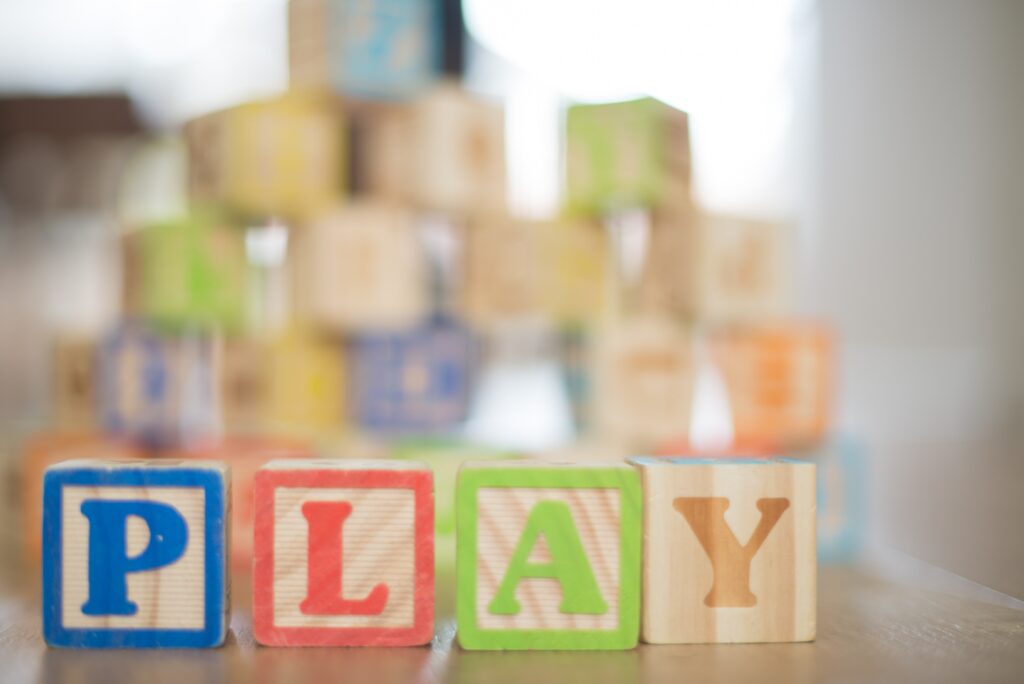
Depth of Field Photography of P, L, A, Y Wooden Letter Decors on Top of Beige Wooden Surface
In recent years, I have questioned much about my teaching practice and the pandemic helped to accelerate these shifts in my work. This year more than ever, I thought about how to put students first and how to lead with kindness. This framework helped me to revise practices such as ungrading in my courses as well as include new opportunities for flexibility such as including asynchronous experiences for a face-to-face course. I mention this because it feels like this new iteration of the play course helps to highlight some of these changes.
Play is at the heart of the course. Naturally, our class conversations focus on the ways that young children play and the developmental benefits of play. But it is more than just discussion, we play every class. Sometimes this play is connected to understanding young children’s play. For instance, when we learn about sensory play, we create doughs and slimes. This provides students with the opportunity to explore these materials and consider the connections they can make to children’s play. But not all of our play is focused on learning about children’s play. An element that I added to the course this semester is something that I called a Play Break. Play Breaks happened during class sessions when we didn’t have the longer play experiences that I just described. Many of my ideas came from Michael Rosen’s Book of Play! Why Play Matters, and 101 Ways to Get More of it in Your Life by Michael Rosen (See 2.5 Weeks + 7 Books = Emerging Ideas About Play for more details). My goal was to provide at least 10-15 minutes of play in every class. Initially I wanted to help students take a break from the more traditional academic tasks of each class session. I also thought that providing more time for play would give students more opportunities to connect to the wellness aspect of the course. What I didn’t anticipate was that it also gave students more time to connect with each other. As I will describe below, we collaborate in small groups very often in this course. So students did have opportunities to talk and learn from each other. But play provides a different context. Play is a space where you can let your guard down because you are engaging in something fun. This helps students to relax. I noticed that as we played this semester that students became more comfortable in this play and this helped to build our learning community as well.
I created an Open Education Resource (OER) during my sabbatical where I curated a list of resources for students to learn about play (See Using Pressbooks to Curate Course Readings for more information). I purposefully provided choice to help facilitate our discussions of play. We used these readings to construct many different shared resources with tools such as Google Docs, Google Slides, Jamboard, and Canva. Sometimes students would work with others that read the same resource from the OER with the purpose of considering key elements to share with others not familiar with the information. Other times they would work in groups where they could learn about resources they didn’t review. This collaborative element gave students time to talk about key ideas from the course and have rich conversations about play. We would come back together as a group and sometimes I would add to the ideas but most often there wasn’t much to add. They thoughtfully discussed and shared this work. This aspect of the course allowed them to learn from one another and highlighted how the OER supported this work by giving students choice in what they wanted to learn about play. As we reflected about our work, the students shared suggestions for changes to the OER that will help to make the user experience better and provide more variety in the resources. I am excited to add to this text because overall I think that this rich resource supported our work and provided the students the opportunity to construct knowledge about play in different ways from previous semesters.
One element that I thought much about as I planned this semester was how I would support students that couldn’t join us for our synchronous in-person sessions. Because of the play opportunities each class, I wasn’t sure that Zoom would be a good fit. I didn’t know how to support play in-person and on Zoom at the same time. I made the choice to not have a Zoom option for this course. Instead, I created asynchronous learning opportunities for each class so that when students couldn’t be in-person they could continue learning and playing remotely. For each class session, I create a slide deck with the key activities for our work. So, this semester as I developed these slides, I thought how could a person engage in this thinking if they were doing this at a different time and in a different place. I decided to use Teams and other collaborative spaces to provide students with the opportunity to share their thinking with the class. I also had to think about the play element for each session. This could be challenging sometimes depending on the type of play we were going to do in class. I knew that students wouldn’t have access to the materials that I have for play. So I had to think about it differently. At first this was difficult, but I decided that I wanted students to have flexibility and that I would do my best to provide a similar experience. These were not the same, but it allowed students to continue their learning. Below you will find some examples of some of these activities.
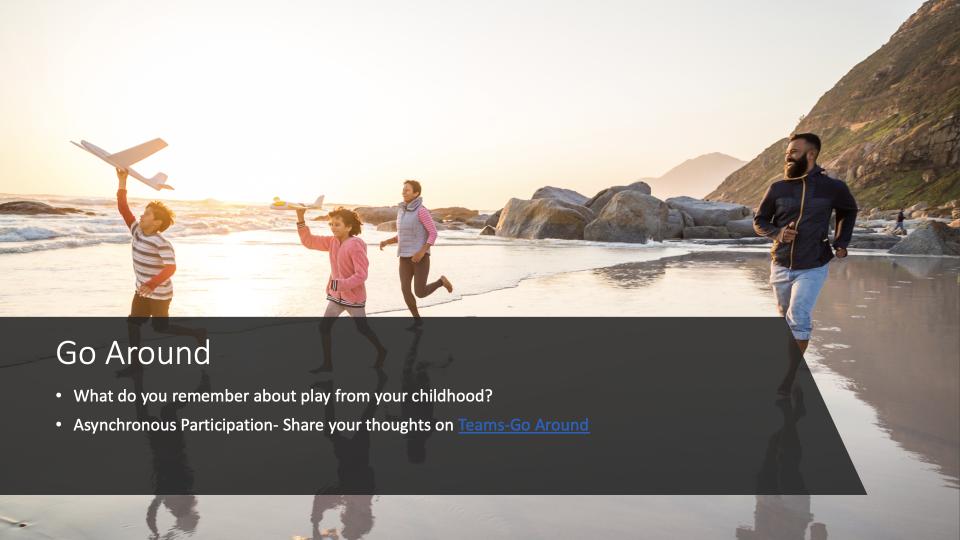
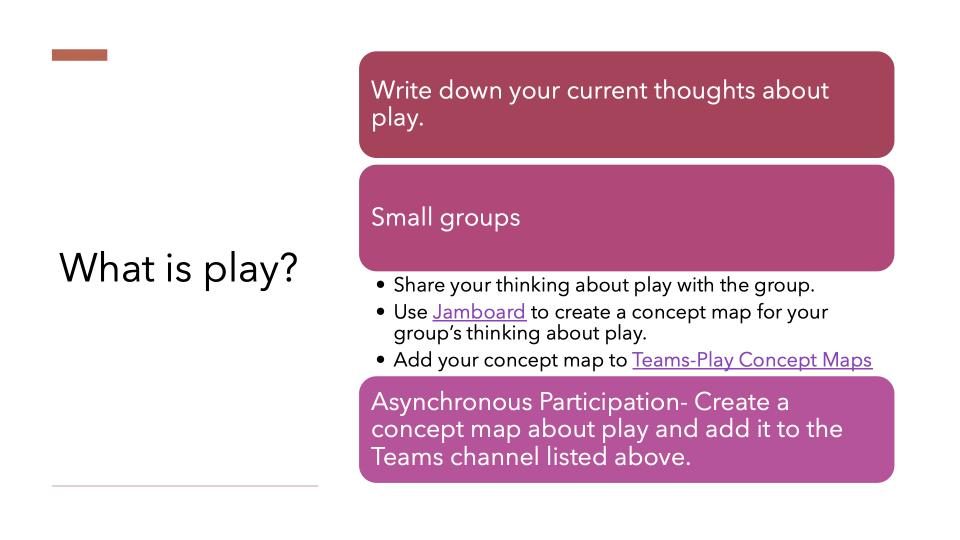
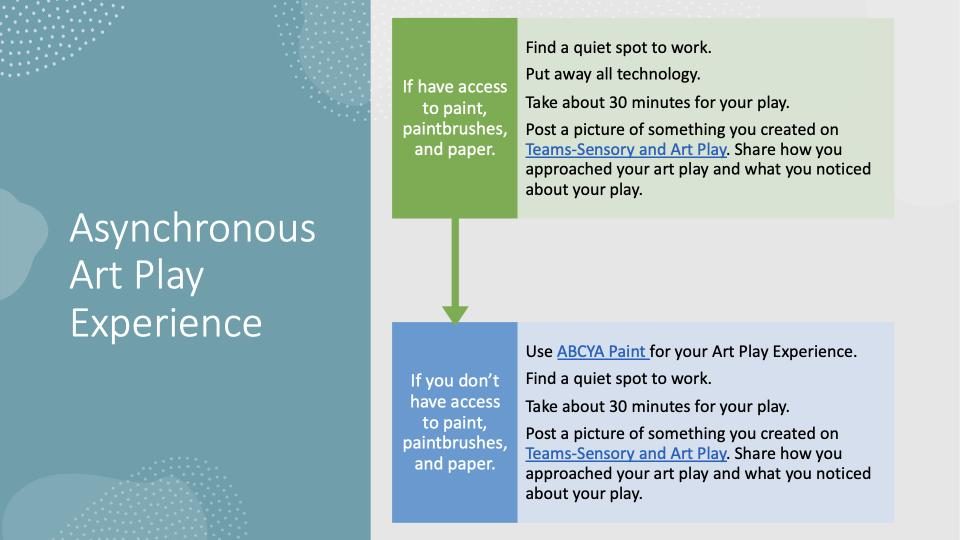
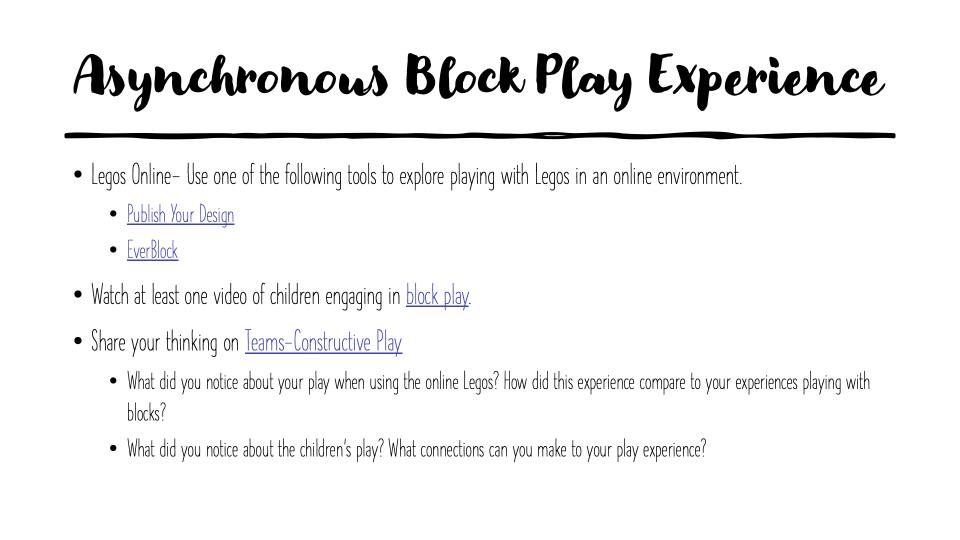
I am so glad that I made this decision. Students used this option often during the semester. Sometimes students would share their thinking in the spaces provided and other times they didn’t, but they had the tools available to them to continue their learning. Below you will find some of the thoughts students shared anonymously in our final Google doc reflecting on these opportunities.
- It was very nice to not have the pressure of needing to go to class when unable to.
- Improves time management and self-regulated learning skills
- Allows for mental health/rest days. (thank you) <- I second this
I wasn’t sure how this element of the course would work. It is clear that students needed this flexibility and paired with the ungrading element of the course, it gave me flexibility as an instructor to learn about my students’ knowledge of play. One student shared anonymously in our final Google doc,
One thing that was legitimately really nice was when someone didn’t come to class for a while, you would reach out and see how they’re doing, as well as try to find a time to meet with them personally. This made it feel like we were still involved and included in the class, and made it more of an individualized experience. This also gave you the opportunity to support us however we needed, eliminating a lot of the stress we’d feel when we’d fall behind.
Although this took time on my part when I planned, I feel that in the end it was a necessary component that helped us all manage a challenging semester. I am already considering how to improve this element for when I teach this course next spring.
This semester was challenging. It was the fifth semester of the pandemic. I lucked out and was on sabbatical in spring of 2021, so it was my fourth semester of pandemic teaching, but I was tired and more importantly my students were tired. Meanwhile, the world tried to shift to a return to “normal”. Despite this context, my students and I played, learned, and I think managed to support each other during this tough semester. Thank you to the students in ER 2155 for your thoughtful work and for playing this semester!